The Challenger
Memories of that tragic day and covering the memorial service at Johnson Space Center

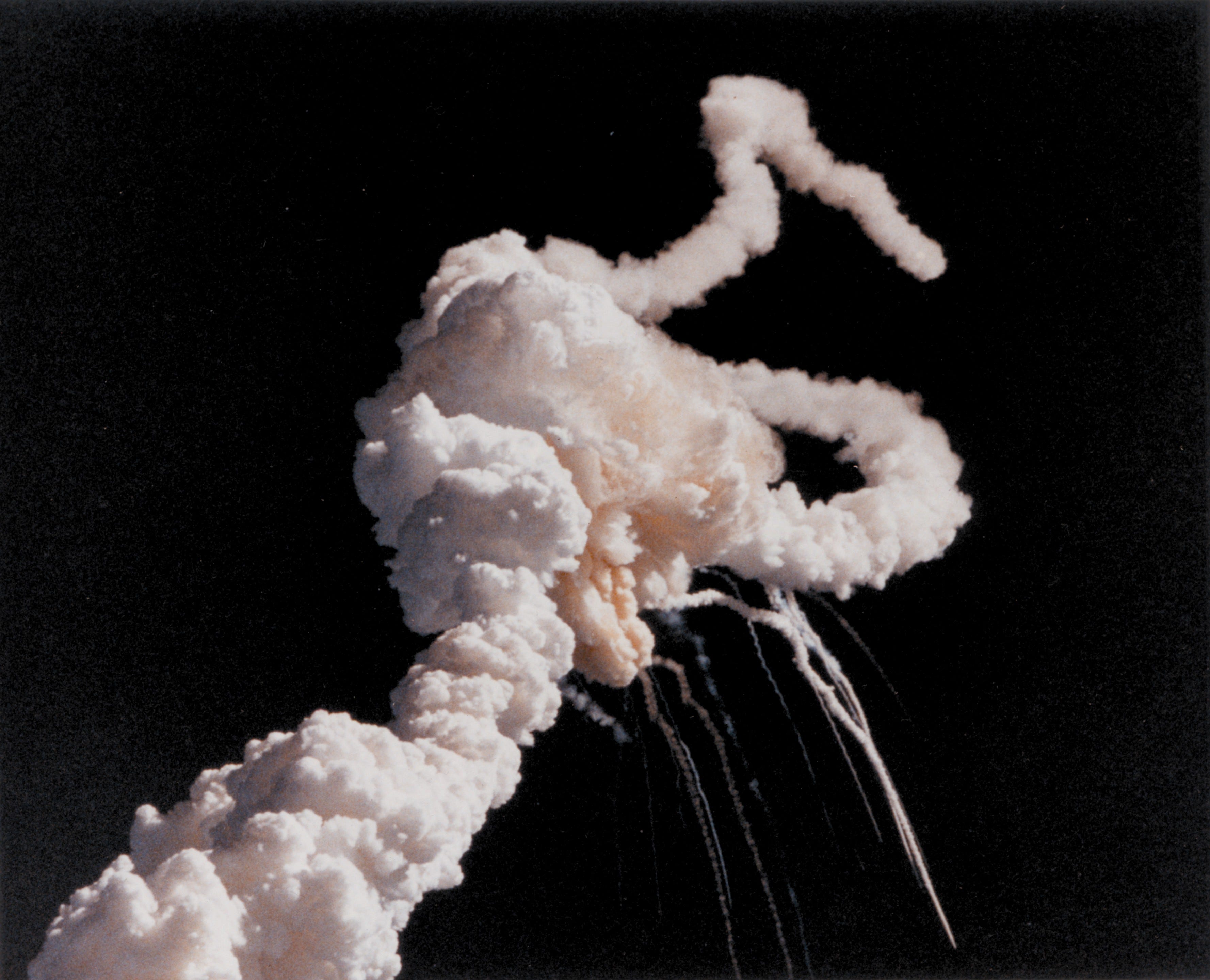
Forty years ago, on January 28, 1986, I was hurrying to my Tuesday morning political science class at College of the Mainland when I spotted the TV on in a nearby office and paused. The space shuttle Challenger was finally getting ready to lift off, two hours after its scheduled launch.
“We’re both running late,” I remember thinking as I stopped and decided to watch, class be damned.
The shuttle mission, the 25th for NASA, had been postponed three times since its first scheduled launch the previous July. The stakes were high in my personal circles and the area where I grew up, just 20 miles southeast of Johnson Space Center.
My second mom, Fran Waranius, was hopeful that the mission, featuring the first schoolteacher in space, would lead to more stable funding for NASA and the nonprofit Lunar and Planetary Institute, where she was the primary research librarian. She, like others, worried that the postponements would draw more unwanted publicity to NASA, which had seen its programs cut dramatically since the end of the Apollo program.

Five of the seven astronauts scheduled to fly still lived in the Houston area. Cheryl McNair, whose husband Ronald was one of three mission specialists, was teaching first grade with my mom at her elementary school.
But it was the teacher on the shuttle, Christa McAuliffe, who was the reason CNN was televising the launch live and in classrooms across the U.S. McAuliffe was the first civilian scheduled to go into orbit under the Teacher in Service Project, a NASA program designed to inspire students and honor educators while spurring interest in math, science and space exploration.
Watching the Tragedy
Eleven days earlier, I turned 21 and celebrated by working the 4 p.m. to midnight shift at the Texas City Sun, my hometown newspaper. The same month, I moved out of my parents’ house into an apartment close to our local community college, where I took the occasional class and lurched toward an eventual degree.
Standing in the hallway, I could see the political science professor looking at me as the class started. Several years before, he had been one of two professors at the college who had been labeled a “socialist” — something he didn’t deny — in a series of scathing editorials by my Commie-hating first boss at the Sun.

Even though the newspaper had changed owners and editors (and thankfully, political stances), I’m pretty sure the professor thought I was a narc working for the man in my blue collar, socially conservative hometown. What he didn’t know was I was just a grown-up kid who worked insanely long hours and, despite having no social life to speak of, rarely went to bed before 3 a.m.
At 11:38 a.m., the shuttle lifted off. Seventy-three seconds later, it disintegrated above the Atlantic Ocean, killing all seven crew members as millions across the country watched live.
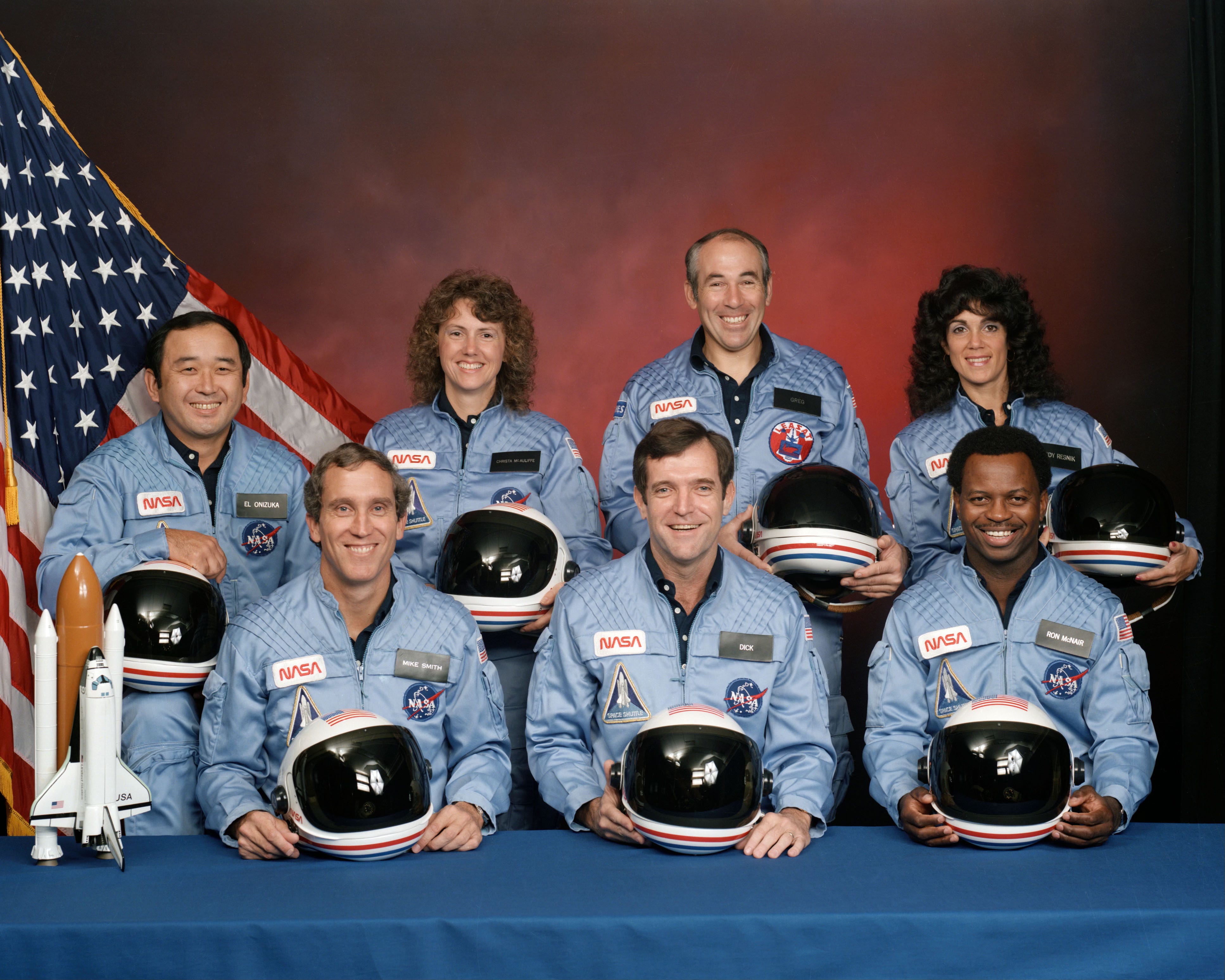
After the initial blanch, you could hear a pin drop. For my generation, it was an event similar to the assassination of John F. Kenndy, or the planes hitting the Twin Towers on 9/11. You can never forget where you were when it happened.
Stunned by what so many collectively had just witnessed, I walked into my class and sat in the back. Minutes later, the class was cancelled and we left in a silent shuffle. I started interviewing classmates and others I could find for a story that would appear the next morning.
Going to the Service
When the Johnson Space Center ceremony honoring the Challenger crew was announced, I called the NASA press office seeking credentials and was told to send a copy of my driver’s license and Social Security card via fax. Because the Sun was considered “local” media and I had covered Vice President George Bush’s tour with Rajiv Gandi six months earlier, we were given access as long as I showed up by 7 a.m. for the 10 a.m. event.

Just after sunrise on January 31, I parked my rusted out 1978 Chevy Blazer in the visitor lot at Johnson Space Center and saw the security guards giving me the side eye. I’d bought the car used for $1,000 from the police chief in a nearby town and even though it ran like a dream, a design flaw left large sections of its body hollowed out by the Gulf Coast’s salty air. It looked like it could disintegrate at any moment.
On that chilly, breezy morning, I showed the guards my Texas Press Association credential and walked toward the area to be screened by the Secret Service. Bleary eyed from another late night at work and little sleep, I was worried, nervous, and convinced I was out of my league.
The Secret Service agent allowed me to carry my Pentax camera inside to the makeshift bleachers as long as I waited to take pictures when the ceremony began, but he took one look at my 35 mm fixed lens and said, “You’re not going to get anything with that.” (He was right.)
The ceremony had been hastily put together but was beautifully organized. President Reagan had cancelled his State of the Union address, scheduled the night of the shuttle launch, and had delivered a memorable speech about the astronauts that evening. Reagan then decided to hold the memorial ceremony at JSC because of its proximity to most of the victims’ families.
The agent handed me off to a colleague and I was escorted to my position on the makeshift bleachers to wait. Because I had arrived early for once, I was one of the first press members there — something my Diet Coke-filled bladder would soon regret.
“Do not move from this spot,” the agent said, the outline of an automatic weapon bulging under his suit, “or you will be asked to leave.”
Other print and radio reporters, photographers, and videographers — local, state, some national — started showing up. I scribbled observations in my notebook, most of which I typed up later but didn’t use in my story.
Directly behind me, on platforms at the top of the bleachers, were Tom Brokaw of NBC, Sam Donaldson of ABC, and Dan Rather of CBS, getting ready to go live before the ceremony began.
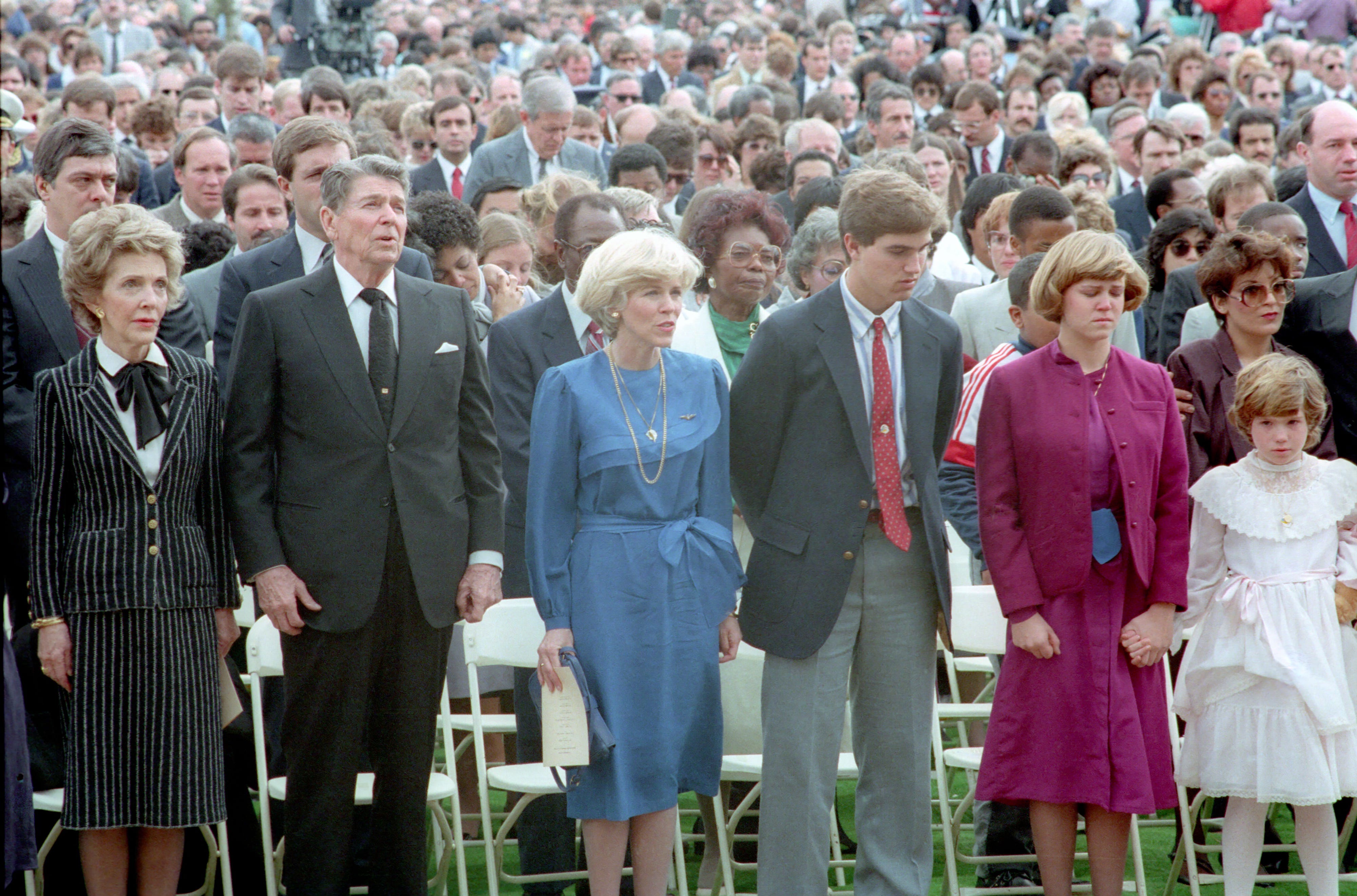
Reagan flew into Ellington Municipal Air Field on Air Force One that morning with his wife, Nancy, and at least 90 members of Congress, including House Speaker Tip O’Neill and Sen. Ted Kennedy. While the Reagans met privately with the families of six of the seven astronauts (Judith Resnick’s family did not attend), members of the White House Press Corps showed up to the bleachers.
A Press Corps photographer wormed his way into my spot and told me to move. Full bladder and all, I refused. When he tried to nudge me out of the way, I looked toward the Secret Service agent and told the photographer to take it up with him. The photographer looked at the agent, who silently shook his head, and backed away.
Lost and Found
After hours of waiting, the solemn, emotional ceremony itself was brief. Reagan spoke for less than 10 minutes, mourning the loss of “our seven Challenger heroes.”
“Sometimes when we reach for the stars, we fall short,” the president said in a quiet, somber tone. “But we must pick ourselves up again and press on despite the pain.”
As family members sobbed and many in the audience dabbed at their eyes, Reagan went on to speak about each crew member. “Words pale in the shadow of grief,” he said. “They seem insufficient even to measure the brave sacrifice of those you loved and we so admired. Their truest testimony will not be in the words we speak, but in the way they led their lives and in the way they lost their lives: with dedication, honor and an unquenchable desire to explore this mysterious and beautiful universe.”
When Reagan’s speech ended, the band from Lackland Air Force Base in San Antonio performed “America the Beautiful.” The crowd joined in, then sang again when the band played “God Bless America” as NASA’s T-38 jets flew overhead in the Missing Man formation.
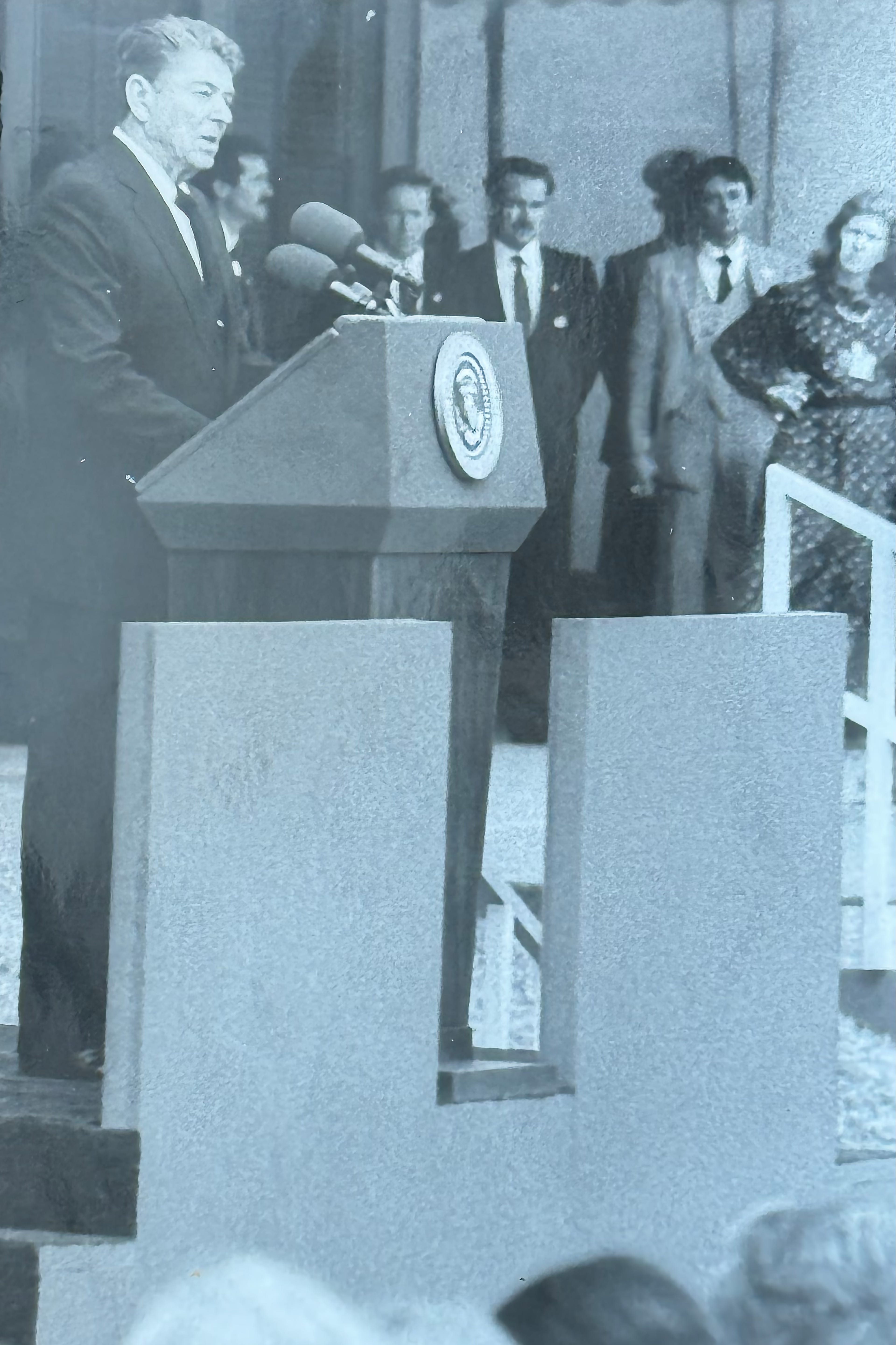
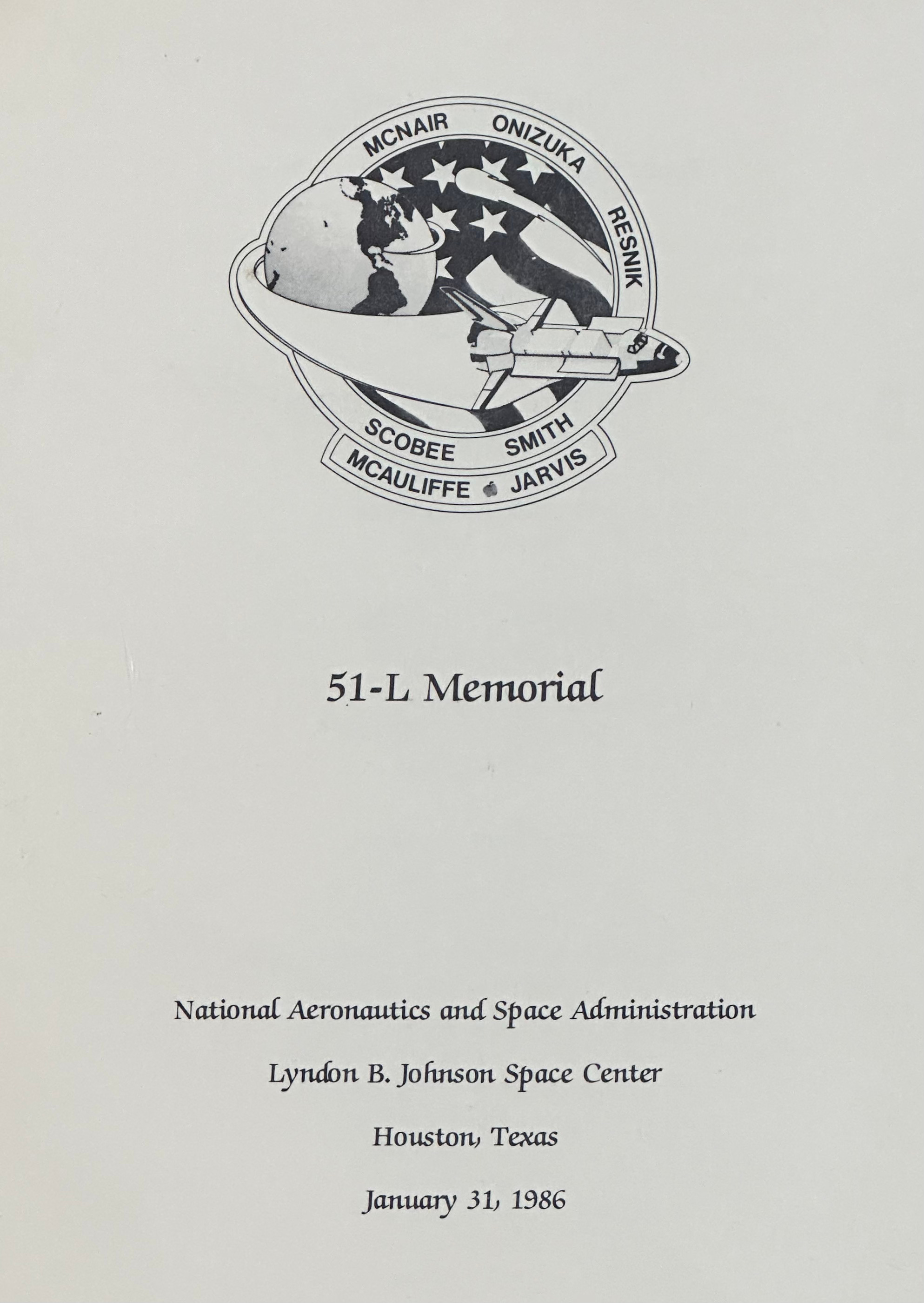
Leaving, I met up with Tricia Wall, the Sun photographer who shot the event with a decent lens from the press pool, and we went to lunch. We both had a beer and picked at our food, drained by what had taken place. I kept my program and a copy of Reagan’s remarks, both of which I still have, along with one of Tricia’s photos. (Mine were from too far away and out of focus, as I recall, and I no longer have the negatives.)
I also can’t find the article I wrote that was in the next morning’s newspaper. Working on this essay, I called the Moore Memorial Public Library in Texas City in the hope they would have a microfilmed copy. (The Sun, like many small town newspapers, closed for good in 2004 and donated its archives to the library.)
Unfortunately, the reel that includes the February 1, 1986, edition is missing. Fortunately, my memory, and many of the notes I took from that tragic day and week, are still intact.
The Challenger exploded while I was flying to Toronto from NY to do a story about the smart professional Canadian childrens musicians Raffi, and the trio Sharon, Lois & Bram. Went right from airport for lunch with Raffi at a small diner near his office. "What a sad day for your country," he said. "I asked, "what happened?" and he pointed me to the little TV. That night I took Sharon, Lois & Bram to dinner at a trendy Toronto restaurant. We all drank vodka martinis. I was taken by this gesture of authenticity: These were grownups living grown-up lives, who happened to excel at folk music for children. An antidote to Smurfism in the USA.
We had one of those schools where the classroom walls were really just dividers that could be opened/closed to reconfigure the space as needed. On this day, all 3 were open, so we could crowd around one of those TVs strapped to an AV cart, which is now a meme. With Christa McAuliffe onboard, I think my teachers were as excited as we were (even if some of us just welcomed the idea of getting out of class for a bit).
After the explosion, no one really knew what to do. There was a bit of stunned silence before someone decided to keep up appearances, roll the TV away, and get on with business as usual. Sometimes I wonder what the chatter in the teacher's lounge was like that afternoon. It had to have been wild.